
What to Do with Leftover Egg Whites and Yolks: A Complete Pastry Guide
The Eternal Baker's Question: What to Do with Leftover Eggs?
Anyone who has ever worked with mousse cakes, curds, or custards knows the scenario: after making a dessert, there's a bowl of whites or yolks sitting in the fridge. Too good to throw away, but not always obvious what to do with them. This guide will help you turn "leftovers" into full-fledged desserts and components.
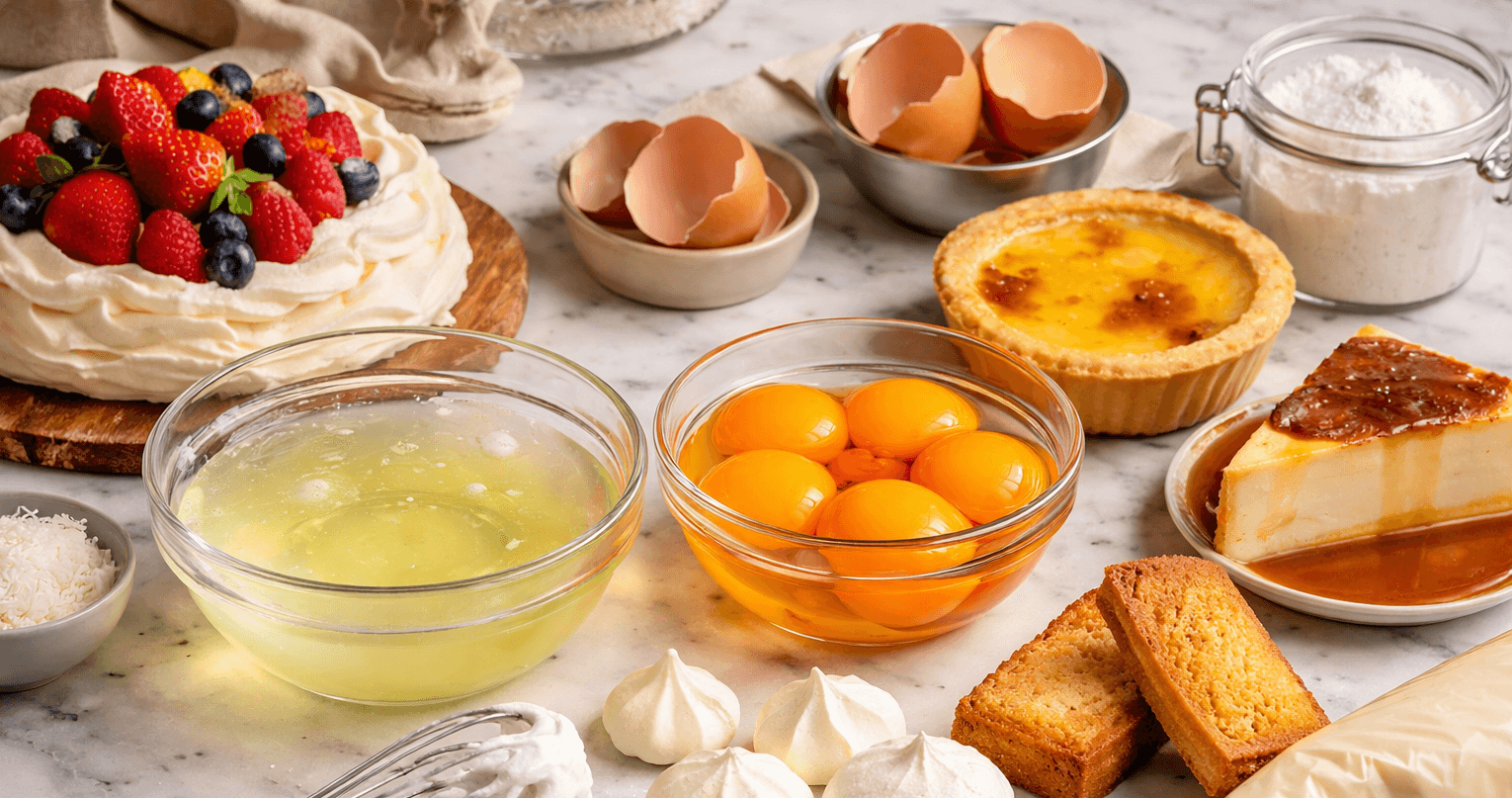
What to Make with Leftover Egg WHITES
1. Meringue and Meringue-Based Desserts
Egg whites are the foundation of any meringue. And from meringue you can make an enormous variety of desserts:
- Baked meringue (Pavlova shells, kisses) — classic French meringue dried in the oven at low temperature (90–100°C / 195–212°F). Crispy on the outside, delicate inside.
- Macarons — the famous French almond cookies with various fillings. Require Italian or French meringue technique.
- Meringue roulade — soft baked meringue rolled with cream and berries. Impressive yet straightforward.
- Pavlova — crispy meringue with a marshmallow-soft center, topped with whipped cream and fresh fruit.
- Mousse fruit cakes — Italian meringue is the base for many mousse fillings, adding lightness and airiness.
- Zephyr (Russian marshmallow) — a delicate dessert made from fruit purée and whipped whites with agar-agar.
- Marshmallow — whipped sugar-gelatin mass stabilized with Italian meringue.
2. Cake Layers and Biscuits
Whipped egg whites are the core of many cake layers used in complex desserts:
- Dacquoise — almond or hazelnut meringue biscuit, crispy and aromatic. The classic base for Esterházy cake.
- Mousse cake layers — light white-based sponges that don't overpower the mousse but delicately complement it.
- Hazelnut meringue — the base for Kyiv Cake. Crispy meringue with crushed nuts.
- Financiers — classic French pastries made with almond flour, egg whites, and brown butter (beurre noisette).
3. Royaltine Wafer (Feuilletine)
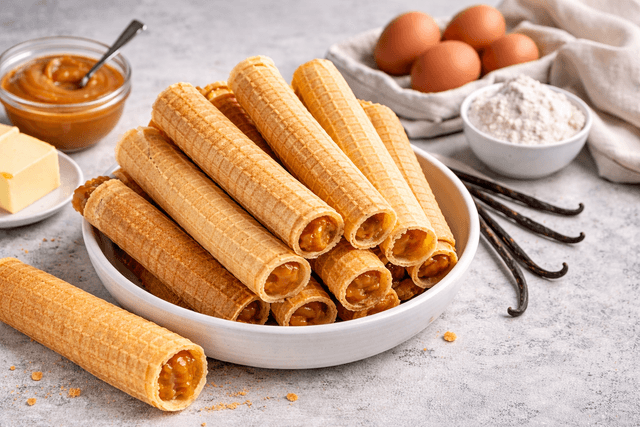
Thin wafer sheets made from egg whites, crushed and used to create the crunchy layer (croustillant) in cakes and pastries. Combined with praline and melted chocolate, it's an essential element of mousse desserts.
4. Royal Icing for Cookie Decorating
A mixture of egg whites and powdered sugar creates classic Royal Icing, used to decorate cookies, create intricate patterns and designs. The whites provide ideal flow and set.
What to Make with Leftover Egg YOLKS
Doughs and Batters
Yolks are fat, lecithin, and emulsifier all in one. They make dough tender, crumbly, and rich in flavor:
- Cake batter — for mousse cakes, cupcakes, and pound cakes. Yolks add moisture and tenderness. Yolk-based sponge has a signature golden color and soft texture. Also ideal for gingerbread and honey cake dough.
- Pâte Sucrée (Sweet Pastry) — sweet shortcrust dough for tarts and cheesecakes. Yolks make it crumbly and short. Holds up well against moist fillings and keeps its shape after baking.
- Pâte Breton — Breton pastry dough, extremely buttery and crumbly. Used exclusively as a base for tarts and tartlets, cheesecake — without sides. Very rich in yolks.
- Pâte Brisée — neutral shortcrust dough for tarts, tartlets, open and closed pies, quiche and pastéis. Yolks provide elasticity and binding.
Creams and Custards
Yolks are the heart of French cream-based pastry. Most classic creams are built on yolks:
1. Crème Anglaise
The foundational custard made from yolks, sugar, and milk (or cream). This is the bedrock on which a huge part of pastry-making rests. Based on crème anglaise, you can make:
- Crémeux — a rich, silky filling for choux, éclairs, and croissants.
- Mousse base — crème anglaise + gelatin + whipped cream = the foundation for a mousse cake.
- Crème brûlée — baked custard with a caramelized sugar crust.
- Curd — crème anglaise with fruit juice or purée replacing part of the milk. Lemon, mango, passion fruit curd — all built on yolks.
- Crème Pâtissière (Pastry Cream) — custard thickened with flour or cornstarch. The base for Napoleon, mille-feuille, Saint-Honoré. From it you derive Crème Chiboust (with meringue), Crème Mousseline (with butter) for Esterházy and Kyiv Cake.
2. Tiramisu Cream
The classic cream made from yolks beaten with sugar and mascarpone. Here, yolks are whipped into a fluffy, airy mass over a water bath (sabayon), then folded with mascarpone and whipped cream.
3. Flan
A French baked custard tart set in shortcrust pastry. A classic Parisian dessert currently enjoying a renaissance — you can find it in the best pâtisseries in Paris.
How to Properly Store Whites and Yolks
Storing Egg Whites
Raw egg whites keep for up to 4 days in the refrigerator in an airtight container. For longer storage, freeze them: whites tolerate freezing beautifully and keep for 2–3 months in the freezer with no loss of properties. Before using, thaw in the fridge and bring to room temperature.
Storing Egg Yolks
Yolks keep in the refrigerator for up to 2 days. In the freezer — up to 1 month, but only if you add 20–25% sugar (or invert sugar, or glucose syrup) by weight of the yolk. Without sugar, yolks become gel-like during freezing and unusable.
Practical Tips
- Write down how many whites or yolks you've saved and the date — this helps plan your next dessert.
- One large egg white ≈ 30–35 g (1–1.2 oz), one yolk ≈ 18–20 g (0.6–0.7 oz).
- Freeze whites in portions (ice cube trays) for easy measuring.
- Mix yolks with sugar before freezing and label the container with the weight and sugar content.
- Thawed whites actually whip better than fresh ones — partial breakdown of protein bonds helps.
Conclusion
Leftover whites and yolks are not waste — they're a valuable ingredient for dozens of desserts. From airy meringues to silky custards, every part of the egg has its perfect use. Plan your desserts in chains: if today you make curd (yolks), tomorrow make macarons or financiers (whites). This way, you'll not only reduce waste but also expand your pastry repertoire.


Comments
Log in to leave a comment. Sign in
Loading comments…