
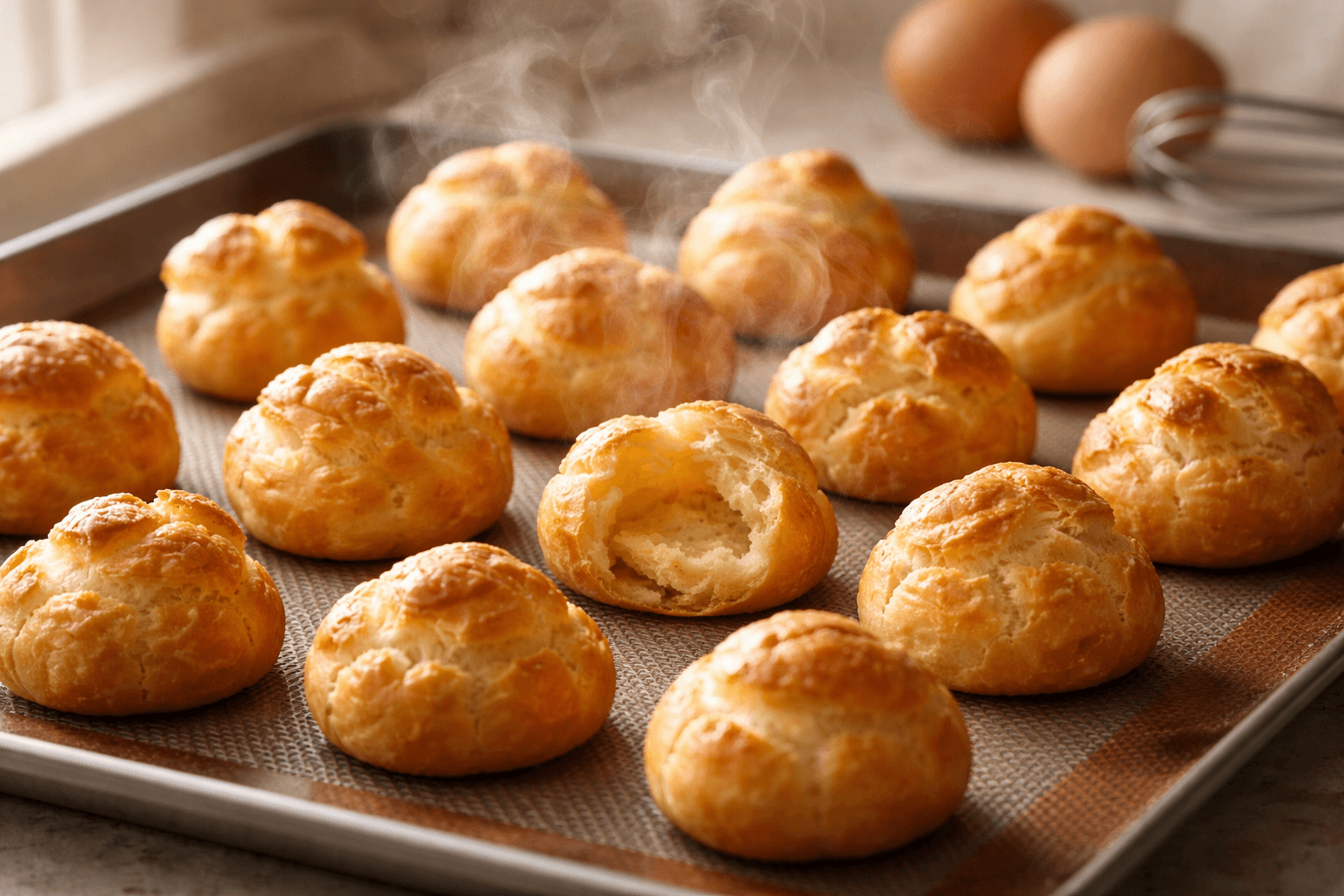
Choux Pastry Secrets: A Pastry Chef's Guide to Perfect Puffs
Choux Pastry: Why Are Some Éclairs Perfect and Others Not?
Choux pastry (pâte à choux) is the foundation of beloved desserts like éclairs, profiteroles, choux buns, and Paris-Brest. It seems simple: flour, water, butter, eggs. But that simplicity is deceptive — small nuances separate a hollow, crispy shell from a flat, soggy disappointment.
Over years of professional work, I've distilled 4 key rules that guarantee results regardless of the recipe. Let's break each one down.
1. Baking Temperature & Time — Only Your Oven Knows
Perhaps the most common question: "What temperature for choux pastry?". The honest answer: there is no universal temperature. Every oven has its own personality, and that's perfectly normal.
What affects the result:
- Oven type — convection dries the surface faster, conventional gives a more humid heat. For convection, 170–180 °C usually works; for conventional, 190–200 °C.
- Size of the pastry — small profiteroles (3–4 cm) take 20–25 minutes, large choux buns or éclairs take 30–40 minutes. The bigger the piece, the longer it needs to fully dry inside.
- Uneven heating — use an oven thermometer. The difference between the set and actual temperature can be 15–20 °C.
Tip: bake a test batch of 4–5 pieces, note the temperature and time. After two or three attempts, you'll know your oven perfectly.
2. Eggs — Always by Weight, Never by Count
This rule separates professional technique from guesswork. Eggs must be measured in grams, not counted by number. Why is this critical?
- Eggs vary in size: a medium egg weighs ~55 g, while a large one weighs ~65 g. With 3–4 eggs, that difference can total 30–40 g — enough to dramatically change the dough consistency.
- Different flours absorb different amounts of moisture. Even the same brand from different batches can behave differently.
The correct technique for adding eggs:
- Crack all eggs into a separate bowl and mix thoroughly until uniform (a blender works best).
- Add the egg mixture to the cooked dough gradually, 1–2 tablespoons at a time.
- Beat thoroughly after each addition until fully incorporated.
- Stop when the dough reaches the right consistency: it should slowly slide off a spatula in a V-shape, holding its form for a few seconds.
Important: you won't always need all the egg mixture. Add to consistency, not to recipe. This is the main secret to reliable results.
3. Bake Immediately? No — Let the Dough Rest
One of the most frequently asked questions, and the answer may surprise you: most professional pastry chefs do NOT bake choux dough immediately.
Why resting matters:
- Gluten relaxes — the dough becomes more elastic, puffs rise better.
- Starch continues to hydrate — the structure becomes more stable.
- Consistency — rested dough yields more uniform results from batch to batch.
Two resting options:
- Room temperature — 1.5–2 hours, covered with plastic wrap. Works when you plan to bake the same day.
- Refrigerator overnight — 4 to 24 hours. Perfect for planning: mix in the evening, pipe and bake in the morning.
After refrigeration, let the dough sit at room temperature for 15–20 minutes before piping so it becomes more pliable.
4. Baking Mat — Perforated or Teflon
The baking surface affects results more than you might think. Here's why:
- Perforated silicone mat (Silpat perforé) — the best choice. The holes allow hot air to circulate under the pastries, creating an evenly crispy base and preventing sogginess on the bottom. Éclairs and choux come out dry and crispy on all sides.
- Teflon mat — a solid alternative. Doesn't offer the same air circulation as perforated, but far better than regular parchment: no sticking, no burnt bottoms.
- Parchment paper — acceptable, but pastries may slide on the surface, and the bottom will be slightly more moist.
Pro tip: if using parchment, glue it to the baking sheet with small dabs of dough at the corners to prevent it from shifting during piping.
Bonus: Why Does Choux Pastry Deflate After Baking?
If your éclairs rise beautifully but then collapse — the most common causes are:
- Under-baked — the pastry looks golden outside but is still raw inside. Keep baking until the color is a deep golden brown.
- Opened the oven too early — do not open the door at all during the first 15–20 minutes.
- Sudden temperature change — after baking, turn off the oven and leave the pastries inside with the door ajar for 5–10 minutes.
Summary
Choux pastry isn't difficult, but it demands precision and attention. Remember four rules: know your oven, weigh eggs in grams, let the dough rest, and use the right baking mat. Follow these simple tips and you'll achieve perfect hollow, crispy shells every time.
Give it a try — and share your results in the comments!


Comments
Log in to leave a comment. Sign in
Loading comments…